Scenario-Based Business Planning: The Smarter Way to Build Resilient Businesses in 2025
Traditional business planning assumed a predictable future. But in today’s fast-changing environment-driven by market volatility, technology disruption, regulatory shifts, and global uncertainty-that assumption no longer holds true.
In 2025, forward-thinking organizations are adopting Scenario-Based Business Planning, a strategic approach that prepares businesses for multiple possible futures rather than a single forecast. This method allows entrepreneurs and enterprises to stay agile, resilient, and opportunity-ready-no matter what the market brings.
1. What Is Scenario-Based Business Planning? Scenario-Based Planning is a structured planning method where businesses create multiple strategic plans based on different future conditions. Instead of asking “What will happen?”, it asks:
What could happen?
How will our business respond?
Typical scenarios include:
Rapid growth scenario.
Moderate growth scenario.
Market slowdown scenario.
Regulatory change scenario.
Technology disruption scenario.
Each scenario has its own action plan, financial assumptions, resource allocation, and risk mitigation strategy.
2. Why Scenario-Based Planning Is Trending in 2025 a) Unpredictable Markets Market cycles are shorter and disruptions faster. Businesses need plans that adapt instantly. b) Smarter Decision-Making Leaders no longer rely on gut feeling-scenario models provide data-backed clarity. c) Investor & Lender Expectations Investors increasingly ask: “What’s your plan if things don’t go as expected?” d) Technology-Driven Forecasting AI-powered planning tools now make scenario modelling faster and more accurate. e) Risk-Aware Growth Businesses want growth without exposure to sudden shocks.
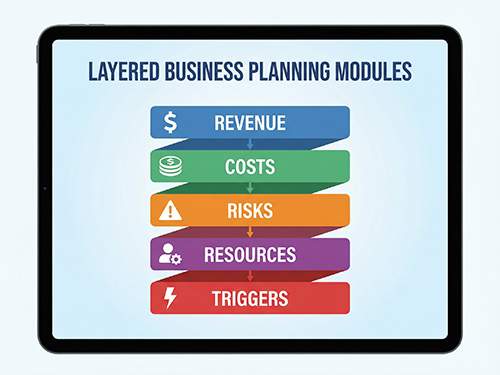
3. Key Components of Scenario-Based Business Planning i) Multiple Revenue Projections Different sales forecasts based on market conditions. ii) Flexible Cost Structures Expense planning that scales up or down quickly. iii) Resource Allocation Models Workforce, technology, and capital planning per scenario. iv) Risk & Contingency Mapping Pre-defined responses to financial, operational, or regulatory risks. v) Trigger Points Clear signals that tell management when to shift from one scenario plan to another. This approach transforms planning from a static document into a living strategy.
4. How Business Planning Services Add Value Professional Business Planning Services help organizations:
Identify realistic future scenarios.
Build financially viable plans for each scenario.
Align operations with strategic goals.
Improve decision speed during uncertainty.
Strengthen investor confidence.
Reduce operational surprises.
With expert guidance, scenario planning becomes practical-not theoretical.
Conclusion
In 2025, successful businesses are not those with the perfect forecast-but those prepared for multiple outcomes. Scenario-Based Business Planning empowers leaders to navigate uncertainty with confidence, agility, and control.
By planning for different futures today, businesses build resilience that protects tomorrow’s growth.








Leave a Reply